Which anodes belong in fresh water, and what eats them at the dock?
Haul-out season is when most boats around Portland get new anodes. It's also the one time a year you can see what the old ones were telling you. An anode that's half gone, one that looks brand new after a season, and a prop that's pitted while everything else is fine all mean different things.
What an anode does
Put two different metals in the same water, connect them with a wire or let them touch, and you've made a small battery. The less noble metal slowly dissolves. Zinc and aluminum are less noble than bronze and stainless, so they go first.
An anode is a block of zinc, aluminum or magnesium fitted so it corrodes instead of your through-hulls, shaft, prop and rudder. It only protects metal it's wired to, through a low-resistance connection, in the same water. A hull anode does nothing for a fitting it isn't connected to.
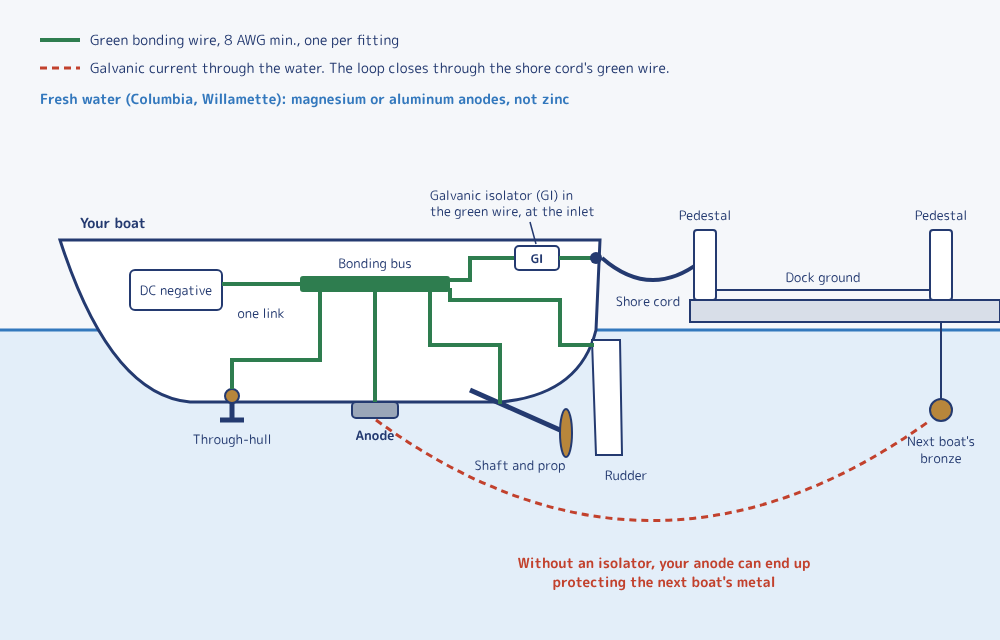
That connection is the bonding system: green (or green-and-yellow) wires, 8 AWG at minimum, from each underwater fitting back to a bonding bus. The bus connects to the anodes and, at one place only, to the DC negative. In normal use the only current in those wires is the small protective current from the anodes.
Fresh water needs a different alloy
Zinc is for salt water only. In fresh water it can build an insulating film on its surface and stop working within months. It looks fine because it's not doing anything.
Aluminum works in salt, brackish or fresh water. Magnesium is for fresh water only, and never goes on a boat used in salt water. Fresh water varies a lot with what's dissolved in it, and magnesium is the one alloy that does the job in most of it. In hard or polluted fresh water it can overprotect, and aluminum may be the better choice.
The Columbia and the Willamette are fresh water, so for most boats kept here that means magnesium or aluminum, not zinc. Advice on aluminum in fresh water varies. We pick one, then confirm it with a reading (more on that below). If the boat makes trips down to the coast, that changes the choice, so plan the alloy around where the boat actually spends its time.
A few rules hold whichever alloy you use:
- Don't mix alloys on one boat. We change every anode together.
- Never paint an anode. A painted anode can't work.
- On a sterndrive or outboard, use the anodes and alloy the drive's manual calls for. Adding protection the drive maker didn't call for can overprotect an aluminum lower unit, which does as much harm as too little.
- Buy anodes marked as meeting the military anode specifications if you can. Traces of iron or copper in a cheap alloy can cut its output or stop it altogether.
What eats them at the dock
Anodes are supposed to wear. The question is how fast. Here's what speeds it up for a boat sitting in a slip all winter.
The shore cord. The green ground wire in your shore cord ties your bonding system to the dock and to every other boat plugged into it. In the water, all that metal acts like one big battery, and your anodes can end up protecting a neighbor's bronze. The fix is a galvanic isolator in the green wire, or an isolation transformer. A good isolator blocks the small galvanic current (no more than 30 mA with 1.0 V DC across it) but still passes AC fault current, so a fault can still trip a breaker. Never cut the green wire or put a switch or fuse in it. Installing an isolator is AC work, and it belongs to a pro.
Stray current from your own boat. This is DC from your own batteries or charger leaking into the water through a fault. Where it leaves metal for water, it takes metal with it, far faster than ordinary galvanic corrosion. As a rough idea: if half an amp left a copper-alloy fitting for a week, that's about 3½ oz (100 g) of metal gone. A common cause is a bilge pump connection sitting in bilge water. Current crosses the water to the nearest bonded metal and corrodes it on the way.
Load current in a green wire. Someone lands a pump or light negative on the bonding bus because it was closer. Now that wire carries load current. A 5 A pump return through a corroded lug with 0.1 ohm of resistance drops 0.5 V. That's more than twice the 200 mV shift a protection system has to make. The fittings sit at different voltages, and current leaves one through the water and comes back in at another.
What to look for while it's hauled out
Replace anodes at every haul-out once they're down to half their original size, and at least once a year. While you're under the boat, these are the warning signs:
- Anodes gone in weeks
- Anodes that look like new after a season, which usually means they aren't connected (or you've got zinc in fresh water)
- One fitting pitted while the rest look fine
- Paint lifting off underwater metal
Hauled out is also the time to check the connections. With a multimeter on its lowest ohms range, touch the leads together and note that reading so you can subtract it. Then run a long jumper lead from the anode to each fitting, probing on bright metal. Every protected part should read 1 ohm or less to its anode.
Inside, look along the green wires. A bare wire pinched under a hose clamp works loose and corrodes. Self-tapping screws at a bonding connection, lugs sitting in bilge water and green crust on a terminal all need fixing.
Afloat, a reference electrode tells you how well the anodes are protecting the underwater metal. The ranges you'll see published are mostly for an electrode made for seawater, which may not read reliably here. In fresh water, use an electrode made for fresh water and follow its own instructions and ranges. Log each reading with the date so you can see the trend.
When to bring in a pro
Get an ABYC-certified technician involved (ABYC certifies technicians in marine corrosion) if:
- Anodes are gone in weeks, a fitting or prop is losing metal, or a reading jumps when a circuit is switched on
- Readings are outside the electrode's ranges, or the boat has a metal hull, aluminum drives, an isolated DC system or impressed-current protection
- You plan to add or remove bonding
- The job touches the AC side: a galvanic isolator, an isolation transformer or the shore inlet
Until a fast-wasting anode is sorted out, unplug from shore power when you don't need it.