Is your bilge pump ready for the wet season?
The rain is back, and a lot of boats around Portland are going to sit in their slips until spring with nobody aboard. The bilge pump is the one thing working the whole time. Most owners never look at it until it stops.
A bilge pump system is meant for rain, spray, a dripping shaft seal and the odd spill. It isn't damage control. If a hose comes off or something opens up below the waterline, the pump's job is to buy you time to find it and stop it. That's worth keeping in mind when you size one.
The five parts
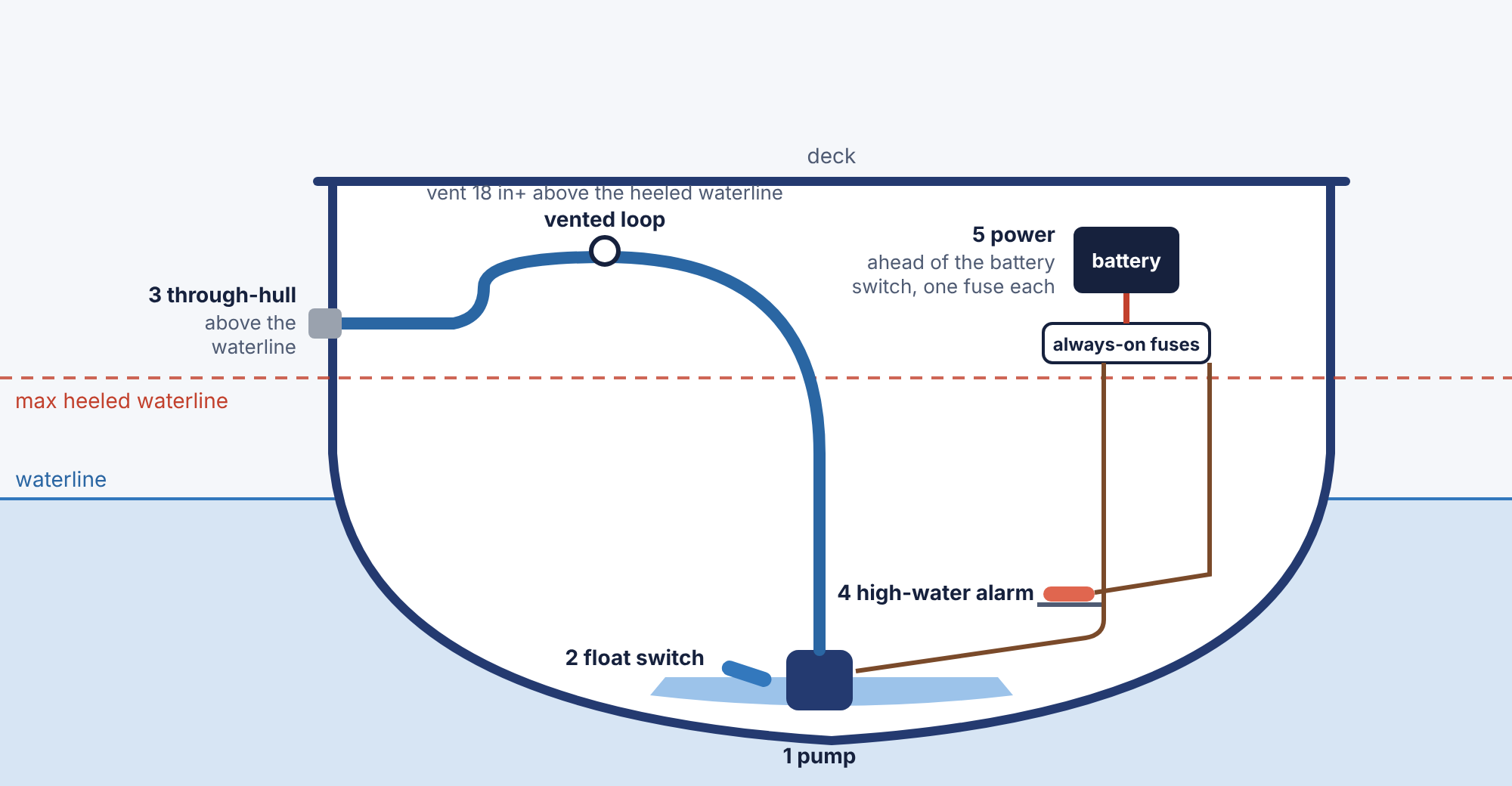
A working system has five pieces:
- The pump, at the lowest point of the bilge, where the last of the water collects.
- A float switch that turns it on when water rises.
- A hose that climbs to its own through-hull above the waterline, with a vented loop if that outlet can end up underwater when the boat heels.
- A high-water alarm on its own float, set higher, so you hear about it when the pump isn't keeping up.
- Power from an always-on fuse block wired to the battery ahead of the battery switch, with the pump and the alarm each on their own fuse. The pump has to run with the boat shut down and the switch off.
Almost every electric bilge pump is centrifugal. A small impeller spins and throws water out the outlet. It moves a lot of water for its size, but it can't pull water up to itself. It only moves water that already covers the impeller. That's why placement at the true low point matters so much.
The number on the box isn't what you get
The GPH on the box is the free-flow rating: no lift, no hose, at a test voltage the maker picks. Every foot the water has to climb costs flow, and so does hose length, every bend, and anything that narrows the line. Here's what one common line of cartridge pumps actually moves, at 13.6 volts:
| Box rating | Free flow | At 3.3 ft lift | At 6.6 ft lift |
|---|---|---|---|
| 500 GPH | 600 | 370 | 220 |
| 800 GPH | 790 | 555 | 340 |
| 1,100 GPH | 1,150 | 870 | 585 |
The little 500 GPH pump loses almost two thirds of its flow by the time it lifts water six and a half feet. So pick a pump by its figure at your boat's lift, not the big number.
Voltage matters too. Those figures are at 13.6 volts, about what a battery sees on a charger. Unplugged, the battery sits lower, and every tenth of a volt lost in thin wire slows the pump down. We size bilge pump wire for no more than 3% voltage drop over the round trip. At 12 volts that's 0.36 volts, total.
Two pumps, not one big one
A lot of boats get one huge pump. In a small sump it empties the water in a few seconds, the float drops, and it starts again a minute later. That short cycling wears out the switch and motor, and the water left in a long hose runs back down every time.
What works better is a small primary for rain and drips, and a larger backup mounted a little higher on its own float and fuse. The backup only runs when water rises past what the first pump can handle. Add a big manual diaphragm pump you can work from the cockpit. It doesn't care whether the batteries are dead, and it passes debris that would stop an electric pump.
Vented loops, and why we leave out check valves
If the outlet can go underwater when the boat heels, the hose can turn into a siphon. Water runs back through the pump into the boat with the pump off and nobody aboard. A vented loop lets air into the top of the hose and breaks the siphon. We like the vent 18 inches or more above the boat's maximum heeled waterline.
Many pumps come with a little check valve in the outlet. We take it out. A check valve can stick shut or clog, and then the pump can't pump at all. It also adds restriction, and it doesn't count as siphon protection anyway. One pump, one through-hull, no check valve, is the simplest system that works.
Two other things we see all the time on older boats: a pump discharge teed into a cockpit drain, and two pumps teed together into one hose. Either way, one can push water back through the other, or choke its flow. Give each pump its own outlet if you can.
The ten-minute test
Do this before the heavy rain, and again after any work in the bilge:
- Lift the float by hand, or press the sensor's test button. The pump should run.
- Fill the sump with a garden hose. Check the float, the manual switch, the light at the helm and the high-water alarm.
- Go outside and watch water leave the through-hull.
- Shut the pump off and make sure nothing runs back in.
- Twist off the cartridge and clean the strainer. Oil and debris are what jam floats.
The light at the helm only shows that the pump circuit has power. It can't tell you the pump is turning or moving water. Only the water test does that.
What to look for on an older boat
While you're down there, look for a check valve in the line, corrugated or undersized hose, a dip in the hose that holds water, a vented loop that sits too low (or none at all), splices sitting in bilge water, a pump wired through the battery switch, a float jammed by a zip tie, a missing alarm, and a spring-loaded manual switch you'd have to hold down in a flood. Green or white crust on a terminal means water got in. Replace the terminal. Don't clean it and hope.
And count the cycles. A pump that runs more often than it used to is telling you about a leak.
When to bring in a pro
Bring in help if the pump cycles often and you can't find where the water's coming from, if the only place for a discharge is below the heeled waterline, if a new hole is needed in a cored hull or below the waterline, or if you smell hot wiring or a fuse keeps blowing. Those are jobs for an ABYC-certified marine electrician or systems tech.