Heaters come out in November. Are your CO and smoke alarms ready?
November is when the cabin heaters come on around Portland. The canvas goes up and the hatches stay shut against the rain. The boat in the next slip starts running its heater too. That's when carbon monoxide has the easiest path to you, and a good time to make sure the alarms aboard work.
What carbon monoxide does
CO comes from anything that burns fuel: gasoline, diesel, propane, wood, charcoal. You can't see, smell or taste it. It's only slightly lighter than air, so it spreads through a cabin instead of sinking or rising. In your lungs it takes the place of oxygen in the blood. A high concentration can kill in minutes, and the effect of lower ones builds up over time.
The early signs are watery, itchy eyes, a flushed face and throbbing temples. Then headache, drowsiness and poor coordination, then nausea and dizziness. People mistake it for seasickness or a drink too many. If several people aboard feel unwell at the same time, treat it as CO.
Where it comes from at the dock
For a boat sitting in a slip this time of year, the usual sources are:
- A cabin heater, water heater or stove that isn't vented the way its manual says, or is overdue for service
- Your own engine or generator idling at the dock (a cold engine makes more CO than a warm one)
- The boat next to you running its generator or heater
CO collects around exhaust outlets, the swim platform and aft seating, and it can hang there after the engine stops. It gets below through open hatches, ports and doors, and through cockpit drains when the cockpit is closed in with canvas. At the dock there's often no breeze to clear it. A generator running beside a seawall or another boat can fill a cockpit.
Two kinds of alarm
A CO alarm doesn't sense smoke, and a smoke alarm doesn't sense CO. A boat needs both.
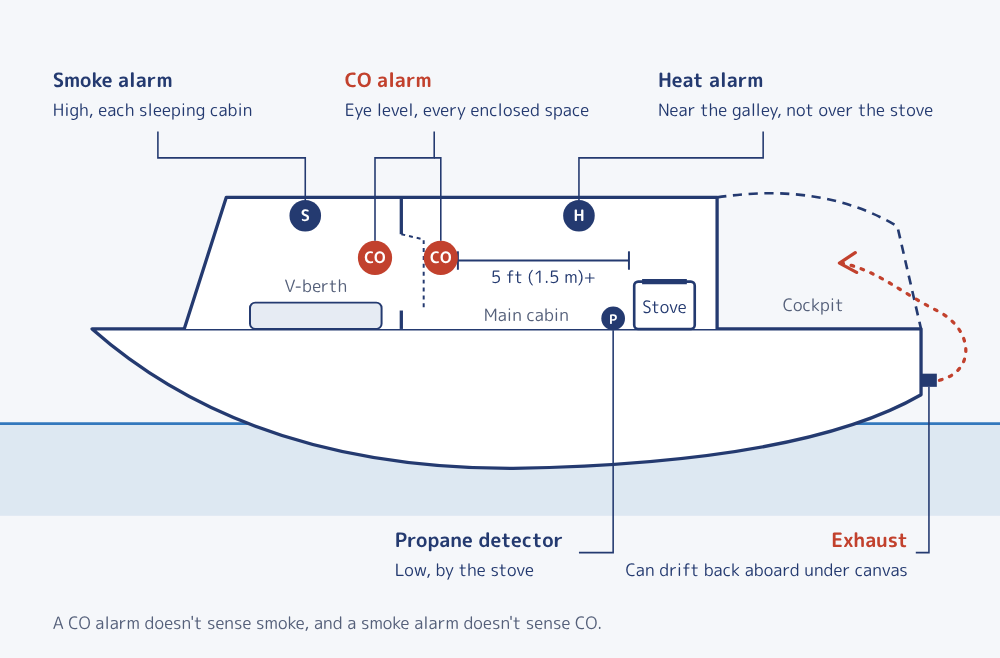
| Alarm | Senses | Where it goes |
|---|---|---|
| CO alarm | Carbon monoxide | Every enclosed space where you sleep, cook, eat, wash, use the head or steer |
| Smoke alarm | Smoke | Each sleeping cabin, up high |
| Heat alarm | Temperature | Near the galley |
| Propane detector | Propane | Low, near the stove |
On most cruisers, CO coverage means the main cabin, each cabin closed off by a bulkhead and door, and an enclosed pilothouse or lower helm. A berth separated from the cabin only by a curtain shares that cabin's alarm. The industry standard for boats built after July 31, 2027 draws the line this wide, which is wider than the older guidance. We use it on any boat.
Use a CO alarm listed to UL 2034, including that standard's sections for recreational boats, and marked as a marine alarm. Mount it where its manual says. A typical spot is at eye level, at least 5 ft (1.5 m) from any cooking appliance and 1 ft (0.3 m) from a corner, a door or other dead air. Keep it out of rain and sun, and away from hatches, ports and vents that would dilute the air it samples.
A hard-wired CO alarm should be fed from ahead of the battery switch, so it stays on when you shut the boat down. If a breaker feeds it, that breaker needs a lock or guard so nobody turns it off by accident. The draw is small. A typical alarm uses 6 mA, about 1 Ah a week, so leaving it on barely touches the battery. A unit with its own battery is fine too, and much easier to fit.
For smoke, fit both ionization and photoelectric types, since they respond to different kinds of fire, or use dual-sensor alarms. Interconnected models all sound when one does. Keep smoke alarms out of the galley. Cooking sets them off, and an alarm that goes off every time someone makes breakfast ends up disconnected. A heat alarm can go near the galley instead, on the overhead or high on a bulkhead, never right over the stove.
Test them, and replace them on schedule
- CO alarms: press the test button at least once a week, and before every trip.
- Smoke alarms: test monthly, change replaceable batteries at least once a year, and replace the alarm every 10 years.
- CO sensors wear out. A typical one lasts about 7 years, then beeps once a minute and flashes its light. Replace it by the date on its label. Don't wait for it to quit.
A CO alarm reacts to dose over time. A typical one sounds after 60 to 240 minutes at 70 ppm, 10 to 50 minutes at 150 ppm, and 4 to 15 minutes at 400 ppm. Symptoms can start before it sounds. If people feel sick, act on that.
Never disconnect a CO alarm because it "goes off for nothing." Find the reason: a boat alongside, a generator, a leaking exhaust hose.
When a CO alarm sounds
Evacuate, ventilate, investigate, then correct, in that order. Get everyone into fresh air first, and don't stay below looking for the source. If it's safe to do, shut down engines, generator, heaters and stove, and open hatches, ports and doors. Get medical help for anyone with symptoms. Check the boats around you too. Don't run anything again until the cause is found and fixed.
Keeping CO out
An alarm is the backup. Fresh air and a sound exhaust system come first.
- Give a stove or cabin heater the ventilation its manual calls for, and keep it serviced.
- Open a hatch or port to keep fresh air moving through. Air drifting forward through the cabin is a sign exhaust could be getting in.
- Don't raft up to a boat running its generator, and don't idle at the dock for long.
- Keep people off the swim platform and aft seating while an engine or generator runs.
- Never run a portable generator on a boat.
Walk through your own boat
Look for household CO alarms, a closed-off cabin with no alarm of its own, alarms next to the stove or under a hatch, alarms wired through the battery switch, alarms past their replace-by date, and smoke alarms with the battery pulled. Write down where each alarm is and its replace-by date.
When to bring in a pro
Stop and get an ABYC-certified technician involved if:
- A CO alarm sounds and you can't find the source, or anyone aboard has symptoms (get medical help first)
- You see soot, water weeping or discoloration at an exhaust joint, or a cracked or loose hose or clamp
- A heater or generator exhaust outlet sits near a hatch, port or cockpit opening