Shore power: what to check every time you plug in
A boat that winters in a slip stays plugged in for months, running a battery charger, a heater or a dehumidifier. That's a lot of hours of current through one plug. Loose connections and corrosion are among the leading causes of shore-power failures and fires, and most of them start at the cord end or the inlet.
How it gets to your boat
Shore power brings 120 V AC (240 V on larger boats) from the dock pedestal, which has its own breaker, through the shore cord to the boat's inlet. From there it goes to the main shore breaker, the AC panel and its branch breakers, then out to the outlets and appliances.
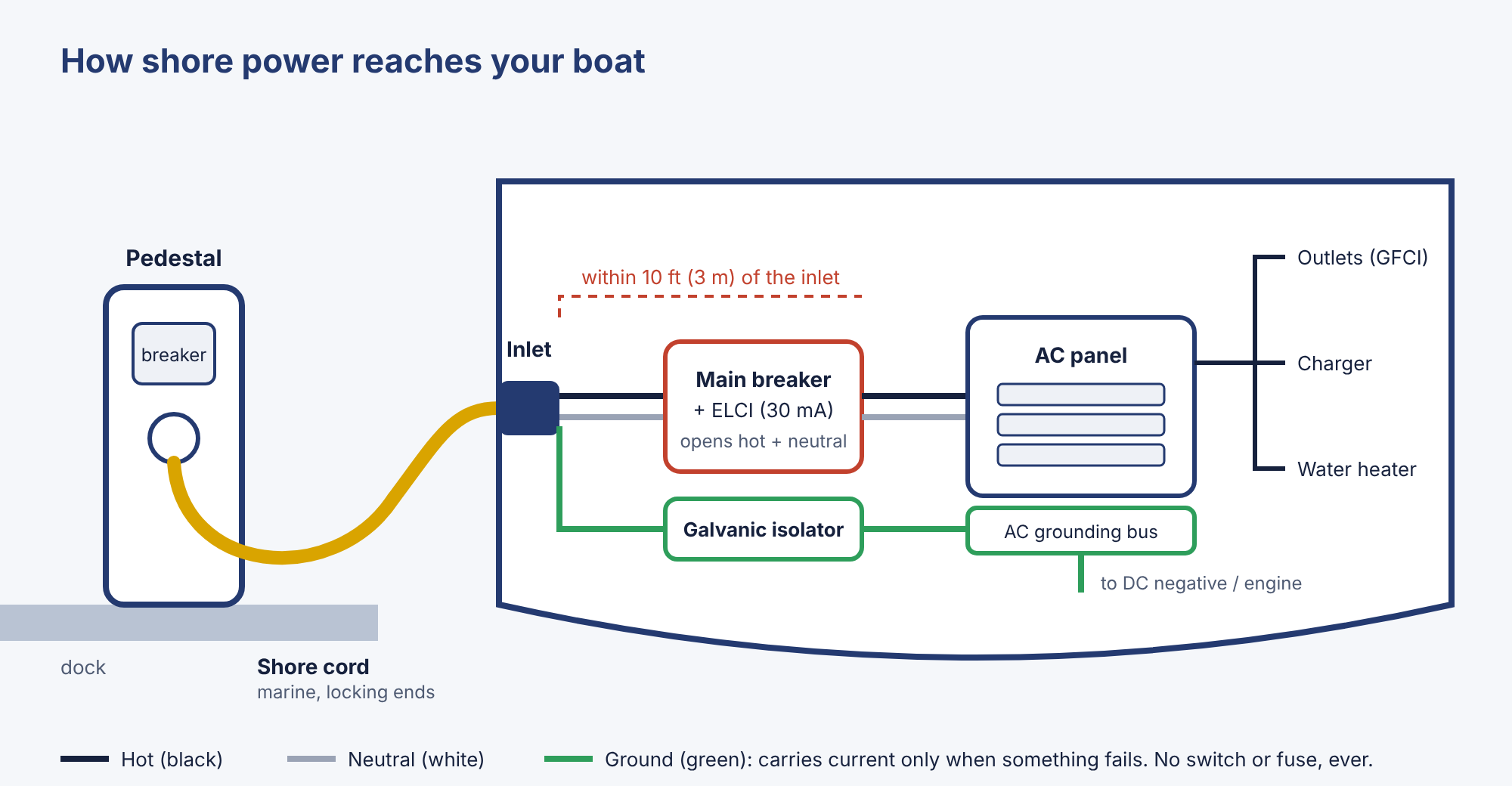
Two wires carry the power: the black hot and the white neutral. The green ground wire runs in the same cable but carries current only when something fails. Then it carries the fault back to the source fast enough to trip a breaker, instead of through a person.
The main shore breaker belongs within 10 ft (3 m) of the inlet, measured along the wire, because nothing protects the wire between the inlet and that breaker. On a 120 V boat it has to open the hot and the neutral together. It should also have an ELCI, a leakage trip for the whole boat. The ELCI compares the current going out on the hot with what comes back on the neutral. If 30 mA or more goes missing, leaking out through the boat and the water, it trips within 100 milliseconds. We add one to older boats too, once any leakage has been found and fixed.
A 30 A breaker won't trip on the few milliamps that can kill a person. The ELCI and the GFCI outlets in the head, galley and on deck are there for that.
What a failing connection looks like
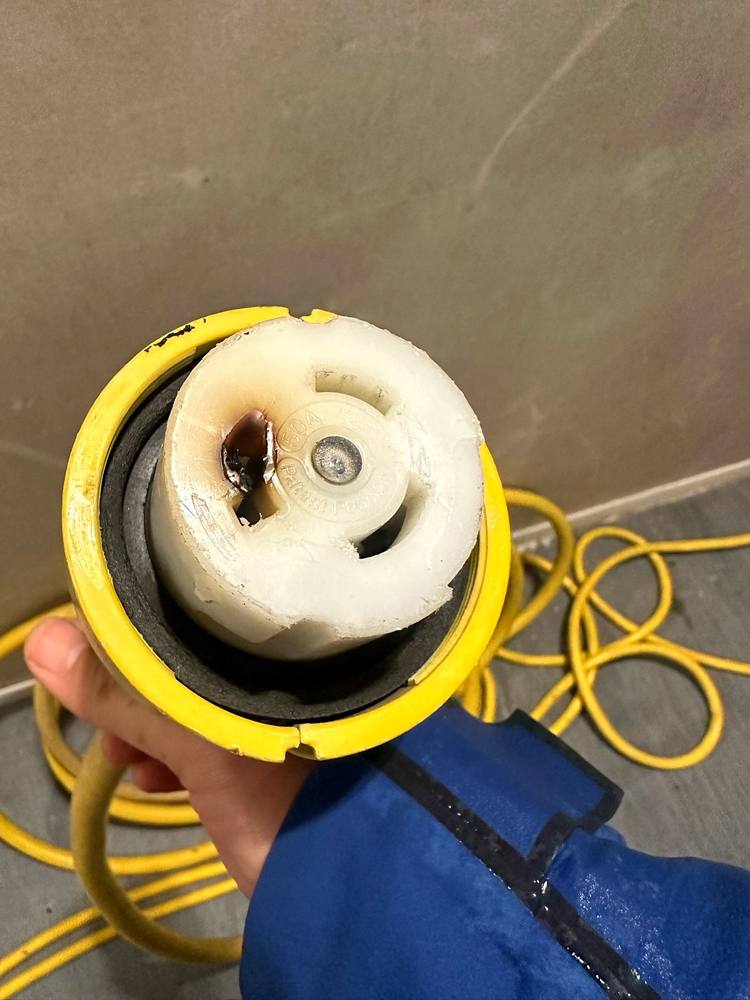
Heat at a plug comes from resistance: a contact that's loose, worn or corroded. Every time it heats up, the contact gets worse. It can go from a little discoloration to a fire while nobody is aboard.
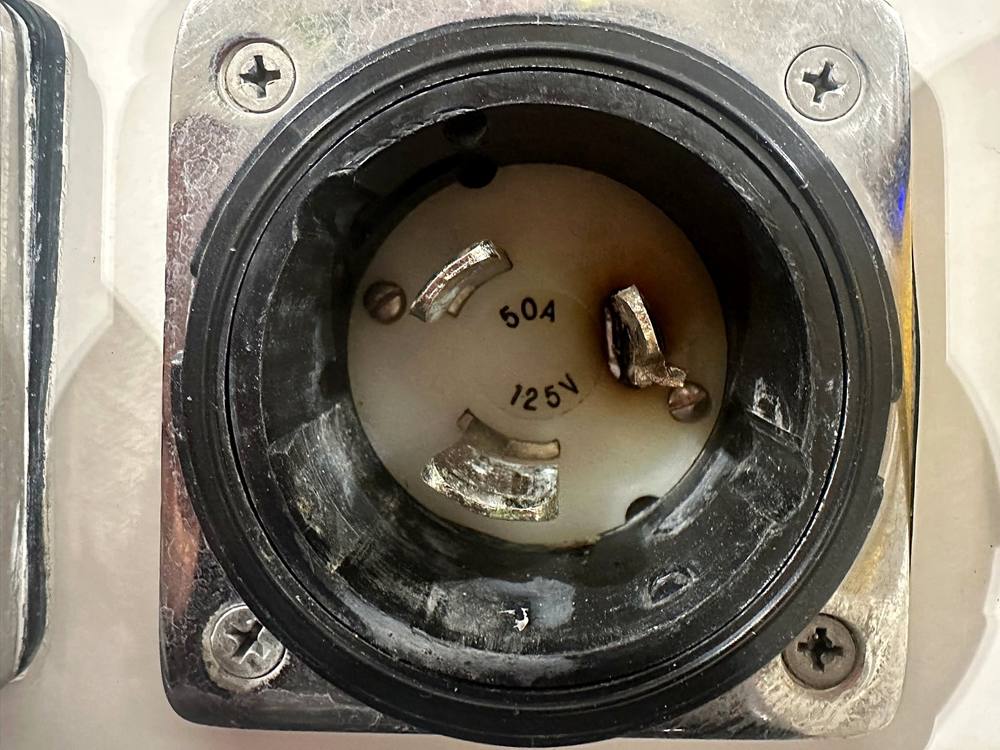
Look at both ends of the cord every time you plug in. Brown or black marks, plastic melted around a pin, or a plug that's warm after an hour under load means that cord end gets replaced. Then look at the inlet or socket it plugs into. If it shows the same marks, replace it too. A new cord in a burnt inlet will burn again.
Plugging in and unplugging
Making or breaking 30 A under load arcs and pits the contacts, so the order matters:
- Turn the boat's main shore breaker off before the cord goes on or comes off.
- Connect the boat end first, then the pedestal end. To disconnect, unplug the pedestal end first, then the boat end. The warning label at your inlet gives the same order.
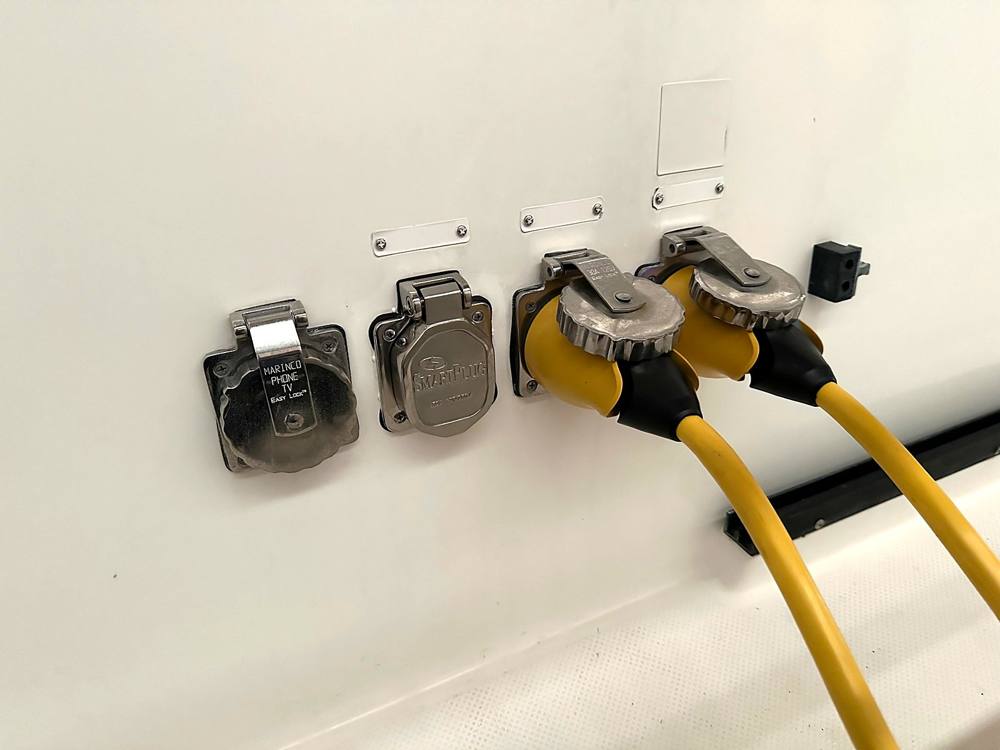
- Screw the locking ring all the way on. When the cord is out, close the inlet cover tight.
- Take the weight off the plug. Hang the cord from a line or a cord keeper, with slack for the tide, clear of the water and the walkway. A shore cord is not a dock line.
Use a marine cordset with locking connectors at both ends. A household extension cord or a homemade adapter doesn't belong on a boat, and an adapter that drops the ground should go in the trash.
Test what protects you
Press TEST on the ELCI and on each GFCI at the interval their instructions give, and before using the system after it has sat unused. Each one should trip, then reset. Write down the date. If one won't trip or won't reset, leave that circuit off until the fault is found. Never bypass it.
If your boat has a reverse-polarity light, check it at every new dock. If it comes on, unplug and tell the marina. With the hot and neutral swapped, a light you've switched off can still be live, and a short may not trip anything.
Never swim near a plugged-in boat
AC leaking into fresh water spreads out from where it enters. Fresh water conducts poorly, so a swimmer's body is an easier path than the water around them. At about 6 to 30 mA a person can't let go, and in the water their muscles lock and they drown. This is electric shock drowning. The Columbia and the Willamette are fresh water, and brackish water near a river mouth should be treated the same way.
Never swim near a dock or a boat with AC power on. If someone in the water near a dock is in trouble, don't jump in. Shut the power off at the pedestal or the dock breaker, throw them something that floats, call 911, and tell them to swim away from the dock.
Your anodes and the green wire
The green wire connects your boat's underwater metal, through the dock wiring, to every other boat that's plugged in. In the water those metals act like one big battery, and the one that corrodes most easily loses. Your anodes can waste away protecting a neighbor's bronze. If yours started disappearing fast after you began plugging in, that's a likely reason.
The fix is a galvanic isolator in the green wire, or an isolation transformer. Never cut the green wire to stop it. That removes the path a fault needs to trip a breaker. Until it's sorted out, unplug when you don't need shore power.
When to bring in a pro
Anything on the AC side beyond plugging in, testing and cleaning is work for an ABYC-certified marine electrician. Get one involved if:
- The ELCI or a GFCI trips and won't reset, or keeps tripping
- The reverse-polarity light comes on, or anyone feels a tingle from metal, a ladder or the water
- You find burn marks, melting, or a hot plug or inlet
- The marina tells you your boat is leaking current
- You want a generator, inverter/charger, isolation transformer, second inlet or 240 V added