Laying up for winter? Keep your batteries alive until spring
Most boats around here don't move much between November and March. The batteries keep working anyway. Something aboard is almost always drawing a little current, and over a few months that adds up to a dead bank.
Switched off isn't the same as nothing running
Turning the battery switch off doesn't stop every load. A properly wired bilge pump runs from an always-on fuse block fed straight from the battery, ahead of the switch, so it can still pump with the switch off. That's how it should be. The battery monitor, a CO alarm and a stereo's memory often sit on the same kind of circuit.
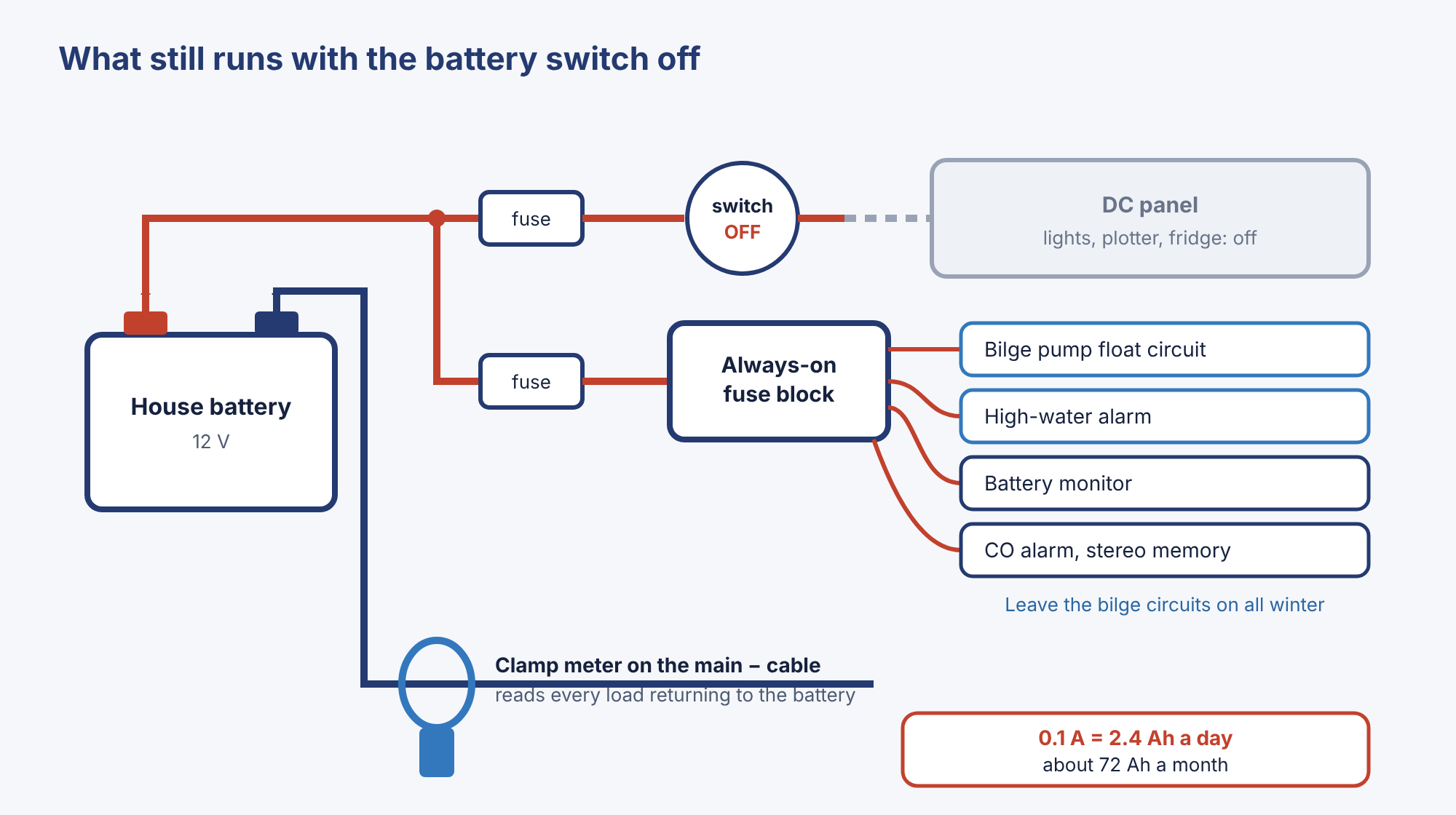
Small numbers add up. A drain of 0.1 A is 2.4 Ah a day and about 72 Ah a month, which is enough to flatten a start battery. Over a four-month layup with no charging, that same 0.1 A takes close to 290 Ah, more than a lot of house banks hold.
Leave the bilge circuit alone. Rain season is when a boat sitting in its slip needs the pump most. The goal is to know what else is pulling current and keep the batteries charged against it.
Know your normal drain
The only way to know is to measure it. Start with the batteries charged, shore power unplugged, chargers and solar off, every load off and the battery switch OFF. Set a DC clamp meter to DC amps, press ZERO with the jaws closed and away from any cable, then clamp it around the battery's main negative cable. Every return current passes through that cable. Some electronics take many minutes to go to sleep, so give it time before you trust the number.
Write that number down. If it's higher next season, something new is drawing power. To track it down, pull one always-on fuse at a time and watch the reading. When it drops, that circuit is the drain. Put the bilge pump and alarm fuses back the moment you're done with them.
A multimeter in series between the post and the cable works too, but a bilge pump starting on its float can blow the meter's fuse. We use a clamp.
Keep them charged
If the boat stays in a slip with shore power, the simplest answer is to leave it plugged in with the charger on. A charger set for your battery type finishes the charge and then holds the bank at float voltage. Check that it's set for the batteries you actually have. A generic "AGM" setting doesn't match every AGM, and a lead-acid setting is wrong for lithium.
Without shore power, a solar panel and a controller set for your battery can cover a small drain. Winter sun in the Northwest is weak, so don't count on it for much. Otherwise, charge fully before you leave and come back to check the voltage every few weeks.
Some batteries have their own rules. Carbon-foam AGMs are built to sit partly charged, but they still want a full recovery charge at least every 30 days. Lithium (LiFePO4) batteries follow their own manual for storage, and many can't take a charge in the cold. One common LiFePO4 battery only charges between 41 and 122 °F (5 to 50 °C), and its battery management system blocks charging outside that range. Read what yours says before the first freeze.
Read the resting voltage
On a lead-acid battery, a voltmeter on the posts tells you the state of charge, but only after the battery has rested with nothing charging or drawing from it. That's at least 4 hours for a typical AGM, and at least 6 hours, preferably 24, for a flooded battery.
| Charge | Flooded (typical) | AGM (typical) |
|---|---|---|
| 100% | 12.73 V | over 12.78 V |
| 50% | 12.10 V | 12.18 V |
| Lowest listed | 11.51 V (10%) | under 11.58 V (0%) |
Your battery's manual has its own figures, and they come first. Lithium doesn't work this way. Its voltage barely moves over most of its range, so use the battery monitor or the battery's own app.
A lead battery that sits half charged all winter comes out of it smaller. The last 20% or so of a charge goes in slowly, and a battery that never gets there sulfates. Hard crystals build up on the plates and it loses capacity it won't get back.
Before you walk away
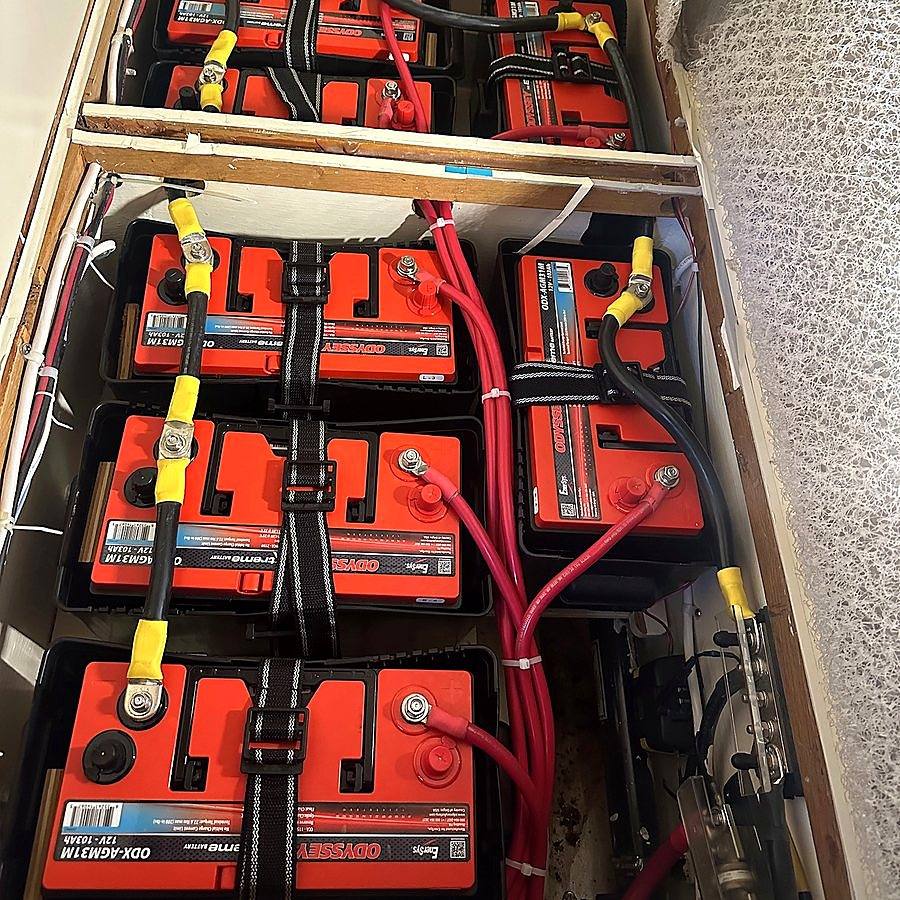
While you're in the battery compartment:
- Check the hold-downs. A battery should not move in its box.
- Look at the terminals for corrosion and missing boots on the positive posts. Torque them to the figure in the battery's manual.
- On flooded batteries, check the water. If the plates are showing, add just enough distilled water to cover them, charge, then top up to the level in the manual. Never add water to AGM, gel or lithium.
- Make sure the box vent is clear.
- Write the date and the resting voltage in your log, so you have something to compare against in March.
When to bring in a pro
Get an ABYC-certified marine electrician involved if:
- A battery is swollen, hot or smells of rotten eggs
- A lithium battery's management system keeps shutting it off
- You're planning to switch to lithium over the winter, since the whole charging system has to change with it
- The drain is well above your normal figure and pulling fuses doesn't find it